Wednesday, April 25, 2012

Diplomacy: it's a serious business*

* sometimes


"Brad Pitt es muy guapo. Me encanta Brad Pitt. Otra vez, chicos...."
In what I suspect is a desperate attempt to keep herself sane in the face of the hoards of know-it-all and overachieving students who roam wild at FSI, my Spanish teacher occasionally breaks from our book's rather staid exercises ("I enjoy learning foreign languages so I can positively impact the world") and inserts her own ("I enjoy Brad Pitt, because he is pretty"). Today was her birthday, which she assured us would be adequately celebrated by her family and friends, and thus we should not feel the need to participate.


Hah.


Feigning non-comprehension ("we do not yet know the conditional, professor!"), we took matters into our own hands.


Our original plan, a cake in the shape of Brad Pitt's head, sadly did not materialize. But, resourceful government employees that we are, we had a back-up.


My role, which I now suspect might have been intended to convey to me that my classmates do not much like me, was to procure sufficient photos of Brad Pitt to create the little Brad-lings you see above. In my naiveté ("Don't they still sell Tiger Beat? Surely the young things simply adore Mr. Pitt...") I was convinced this would be quite easy. In fact, I wound up having to buy four different celebrity gossip magazines to come up with the 11 photos above -- and were it not for Mr. Pitt's extremely thoughtful decision to make an honest woman of one Angelina Jolie last week, it probably would've taken 10 magazines.


Alas, I don't think I'll ever be able to go to that Barnes & Noble again... in a desperate attempt to convince the salesperson the magazines were for my slightly daffy, house-bound younger relative, I also bought two books about African history. I don't think he bought it.


However, it all turned out to be worth it, as our "Torta de Muffins y Brad Pitt" turned out quite well. She was definitely surprised...

"Cual Brad es su favorito?"


Sunday, April 15, 2012

The Reality of My Progress

This week, for the first time really, it's begun to sink in that my rapid progress in Spanish means it's very likely I'll be able to get out to Africa early -- potentially two months early. My training schedule is organized right now to have me out of here sometime during the month of December. However, I'm already about six weeks ahead in Spanish so, assuming I keep up this pace, I should be able to re-schedule some of the training I'm supposed to take in October and November for July and August, and leave after I finish my last course -- the basic consular class -- at the end of September.


This is beginning to scare me a little. I was discussing with a friend over the weekend that I bought a bunch of loose-leaf tea at the beginning of last winter and I have most of it left, thanks to a combination of factors including that our winter was incredibly mild; that my schedule was a bit topsy-turvy because of my joining the Foreign Service; and the odd fact that, for a while now, tea has been making my stomach hurt. My friend reminded me that it's no big deal: winter comes around once a year, right?


Well, if I leave here in October, it doesn't. If I leave in October, winter doesn't come around again until about 2014.


If I leave in October, I definitely don't get to attend my sister's college graduation, or one more Thanksgiving. There will definitely be no Snowtorious B.I.G for me in 2012. I'll miss the entire 2012-2013 season at the Shakespeare Theatre Company. The chances of me getting to see The Hobbit on the big screen: practically nil.


Of course, there are huge upsides. I took a small pay cut to join the Foreign Service, but my lifestyle did not experience similar tightening and, as a result, I could use the head-start on my pay increase overseas. My poor, bedraggled car won't have to make it nearly as long before it wanders off into the wilderness to die a slow, painful death. Or whatever old Jettas do. On the career front, getting to post two months early means I'd be on the summer bid cycle instead of the winter bid cycle, which means I'll have more jobs to choose from when it comes to my second assignment. Since my predecessor will have left by October, any day sooner I arrive is one day less post has to cover an empty job, which is always tough, but especially tough for a small mission. And, well, October is the beginning of the dry(ish) season in Equatorial Guinea, soooo... fewer mosquitoes to greet my arrival. I have a feeling that may be key to my enjoyment of my new home. Given my general attractiveness to mosquitoes and other bug life.


So I'm weighing the pros and cons. In the end, it doesn't really matter which side wins: if the Department decides it's better for me to arrive early, I arrive early. Which of the two options I like better really isn't one of the criteria they use in making that decision. So, stay tuned. 

Saturday, April 7, 2012

You Spin Me Right 'Round

Over the past two weeks, I've been experiencing a bit of what can be a little unsettling about language learning at the Foreign Service Institute: class switches. Right now in the Spanish department, we have over 200 students, and their general goal is to have about 4-5 students per class, which means we have over 50 classes. As nice as it'd be to come in, be assigned to one group, and stay with that group for your entire five months of language, it hardly ever happens.


There are a number of reasons why that's the case, but the number one reason is that everyone learns at a different pace, and there's no way for them to know with 100% certainty when they assign students to groups that they're putting four people together who are destined to learn at exactly the same rate, who will get along and never experience personality conflicts (after all, we DO spend four hours a day together talking about the same things over and over...), and who will have identical learning styles and needs, making them suited to sharing teachers forever.


So, as a result, the department periodically reviews their classes. New students come in and need to be placed in groups; other students test early and leave, or are clearly ahead of their groups and need to be moved to groups that are further along and more advanced. In my case, the latter was true back in mid-March.


It was clear about two weeks ago that I was ahead of my group and would need to be moved up. I took my first intermediate progress test halfway through my fourth week, and had achieved the level that would've been expected after 7 or 8 weeks. I was overjoyed -- personally, I felt as if I hadn't been progressing fast enough and was worried that I wasn't working hard enough. Unfortunately, the rest of my class was more on pace with the department's mean -- at three and a half weeks in, they were where they should've been at, well, three and a half weeks. And that disparity was beginning to cause some tension in our little group. At my current level, my teachers say I need to do a lot of talking, to improve my fluidity and get used to expressing increasingly complex ideas in Spanish. My talking, however, was sucking up a lot of the oxygen in the room, and my classmates, well...they were beginning to notice.


So the department agreed it would be a good idea to move me forward, and this week I joined a group that's been studying for about 13 weeks -- i.e. a full 7 weeks longer than I have. This is pretty great news for me, because it offers up the possibility to finish language early, and then to move on to other training early, and maybe even get to post earlier than I'm scheduled to arrive right now. Updates on that to follow for sure. This new group is much closer to my conversational level, so I don't stick out as much, and it allows me to have conversations with other students, instead of just with my teachers. Smiles all around. Hopefully I'll be sticking with this group for awhile.


However, even if I do, the department has other tricks up their sleeves to make sure we don't get too comfortable...or too stagnant in our progress. Every four weeks, the department rotates our teachers, so we get to experience a new style of teaching and, in many cases, a new accent: my first teacher was Peruvian, with almost no accent to speak of, and my second is Spanish, with a very different way of talking. Other teachers in the department, especially the Cubans and Argentinians, are known for their stronger accents. It's a very good thing, because I have no idea what Spanish actually sounds like in Equatorial Guinea, so I'm quite fond of the idea of becoming familiar with as many different accents as possible.


On the whole, much to my surprise, I'm really starting to enjoy Spanish. I find the language itself interesting, and the fact that, after just six weeks, I can actually have real conversations on serious issues is a tremendous positive reinforcement. At this point in Russian, I could barely mumble out a few sentences about my family and past history. Last week, we had a rather interesting conversation about the health challenges facing rural women in Guatemala, and the difficulties African countries have forming strong national identities due to their sometimes arbitrary borders and their peoples' tendency to have stronger affiliations to their tribe than to their country. Albeit, in slightly shorter words. We'll see where I am in two weeks!

Wednesday, March 28, 2012

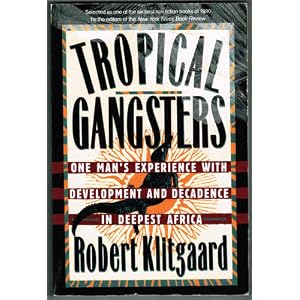
Book Review #1: Tropical Gangsters

An eye-opening experience. 
A few days ago, I finished the first of what I hope will be many books about my soon-to-be home. Tropical Gangsters, which was published in the early nineties by an economist and advisor who spent two years in Equatorial Guinea attempting to get a World Bank project to reform the country's economy underway, is one of very, very few books actually to focus entirely on the country, and it was written before the discovery of oil and subsequent explosion of money in the economy. 


The Equatorial Guinea Klitgaard describes is very different from the country today -- the government had so little money they could barely afford to pay their ministers, and the prospects for raising additional revenue looked rather grim: the cocoa industry, which had once thrived in the country because of the excellent volcanic soil on the country's main island, was in decline and the world market was sinking even faster, meaning that pumping lots of aid into that sector was a pretty crummy idea in the long run. The book describes a place where electricity and water were extremely infrequent, where people had basically accepted that nothing was ever going to get better. 


Of course, it's difficult to judge now how useful this particular batch of information was. I certainly learned a lot in Klitgaard's descriptions of his continually aborted attempts to get reform projects off the ground about the culture of the country, about its people and their history, their attitude towards foreigners, and that sort of thing. Seeing the government (not really) work, getting a glimpse into their bureaucratic culture, even their style of running meetings, was also pretty instructive (though I was not at all overjoyed to read his constant reminders that the humidity and lack of A/C caused him to continually sweat through his suits -- the suits that are customarily worn in business settings. Sigh). 


However, what I liked best about the book were his descriptions of the island itself. My decision to buy a 4x4 was validated over and over in his anecdotes about hopping in the car with his surfboard, crashing through the bush to find new paths down the beach. I just hope that's a possibility. He describes amazing fish available an hour away from the capital at the island's only white sand beach. He says that the rainforest is much less dense than rainforests elsewhere, making it quite lovely to look at. And his description of the city make it clear that, even though it was definitely in need of reform and renovation in the late '80s, it had (and hopefully still has) a lot of charm. 


All-in-all, this book gets a solid 9 out of 10 from me. Klitgaard's writing is amazing -- it's pretty clear he's an awfully intelligent guy and a talented economist, but the book never reads like a textbook. In fact, he's smart enough to leave the bulk of the economics out of the book entirely, instead focusing on a series of vivid experiences. This includes the last 50 pages, which chronicle the end of his time in the country and his growing disillusionment with the government and its ability (desire?) to reform and tackle corruption, human rights abuses, and a host of other problems which plagued the country at that point. 


Does it end on a high note? Surely not. But it's given me a number of things -- both positive and negative -- to think about and to expect when I get there. 

Wednesday, March 21, 2012

Studying my Area


This past Tuesday marked our second week of Area Studies, which so far have proven to be one of my favorite things about training. As I've mentioned in brief, Area Studies are something akin to a weekly graduate-level seminar on our prospective countries or regions. For three hours once a week, we meet with a group that consists of most of the people who'll be heading out to our part of the world over the next few months to discuss some aspect of the region's history, culture, or current affairs. Most of us are full-time language students who take a few hours out of class that day for Area Studies -- a much needed break which, at the very least, gives us something new to talk about in language class (a godsend for our poor fellow classmates, who've had to hear the same monologue on what we do in our spare time in the same 40 words of broken French, or Spanish, or whatever, over and over for the entire week...). 

In my case, since my Area Studies class covers all of sub-Saharan Africa, the group is fairly large. We're also pretty diverse: though the vast majority of us are currently studying French, we have a fair number of Portuguese students headed to Mozambique, Angola, or Guinea-Bissau; Swahili students headed to East Africa; a few Arabic students destined for Djibouti, Sudan, or Eritrea; and, of course, me, the lone Spanish student in the bunch. 

So what sorts of things do we study? Pretty much what you'd expect. We'll have lectures on the history of Africa (pre-colonial, colonial, and post-colonial), lectures on governance, discussions on the role of religion and family in African societies, and hopefully some classes that focus on contemporary issues: the African Union, trade and economic growth, the role of China in Africa, and so on. 

I don't envy our course coordinator or any of the staff in the African Area Studies division. Trying to organize a course for students going to Ethiopia, Senegal, and Namibia can't be easy -- I'm finding that I need to read entirely different sets of literature than my colleagues headed to neighboring countries, let alone those a thousand miles away. But so far, I'm enjoying the new experience. The one big advantage to knowing next to nothing about Africa is that it's awful hard for us to discuss anything in class I've read before. 

Speaking of reading....unlike in grad school, where my professors displayed an almost childlike optimism in their students' abilities to get through several thousand pages a week, despite significant evidence that we were categorically opposed to doing so,  our course coordinators admitted from the get-go that assigning more than a few hours a week of reading for class was a non-starter. Fact of the matter is, as much as we'd all earnestly like to plow through the literature on our countries, one of the expectations of our language classes is that we spend several hours outside of class each day doing homework. Sadly, lest I forego showering and cleaning my apartment entirely, getting through a book a week on Africa isn't turning out to be possible.  

Nonetheless, we're expected to read two books on our posts during the 20 weeks of class, and to read an article or two related to each week's topic, and thus I'm running up against a familiar problem as I prepare for Malabo: the complete and utter lack of preparatory material on Malabo. 

It's taken quite a few hours in several local libraries, and a heavy hand with the "Click to Purchase" button on my Kindle, but I've assembled quite a reading list, which I'm determined to get most of the way through before I depart. Or, at the very least, within my first few months in country. I'm hoping to get all of the reading heavy on post-colonial African history and development over with before the honeymoon period concludes and I settle into one of the, uh, lower reaches of the traditional culture shock curve. Like this one: 

Note: During phases two and three, I intend to read only happy stories involving free high-speed internet and abundant running water.

So, without further ado, and, in case anyone out there is interested in reading more about Equatorial Guinea without having to work very hard to find out what books are out there, I present...

Ashley's Super-Fantastic, Authoritative, And Not At All Depressing 2012 Annotated Reading List!

Books Actually About EG


So, one thing to point out is that the overwhelming majority of these books were published well before the country's recent oil boom and spurt of development, and thus their utility is...well, we shall see, won't we?

Books About Africa And Thus Highly Relevant, Even if Not Entirely About EG

Also in this list should be Guns, Germs, and Steel, which I would like to re-read, and The J Curve, which I would like to finish. 

Books About Travel That Are Not Depressing, But Also Not Really About EG All That Much

  • Lonely Planet Africa This guidebook, which comes in at well over 1000 pages, contains 12 whole pages on the country of Equatorial Guinea. But, believe it or not, they're far and away the most helpful 12 pages I've read thus far. It has maps. And restaurant listings. Oh, praise be... It also contains nice color photos of other places in Africa I can think about traveling to. 
  • The Rough Guide First-Time Africa 2 Contains lots of helpful information about how to get along in Africa if you are, like me, a Euroweenie. I found it somewhat frightening and stopped reading, but plan to return to it as my fortitude increases. 


Books I Will Probably Try to Read As Soon As My Spanish Is Good Enough, So, Yeah, Probably After I Leave EG


So, after you've perused this list, the only question I have left is, uhm...when are you coming to visit?

Friday, March 16, 2012

The Big Things List

As I said a few weeks back, I have a long way to go before I start thinking about, let alone preparing for, my move to Africa. There's a lot to do, to be sure, but the State Department is constantly moving thousands of people all over the place, and they've got it down to a science. Generally speaking, we can't plan anything, from shipping our household effects, to booking our tickets, to getting our passports and visas, to getting our cars delivered to the nearest port, until a few weeks -- at most a month or two -- before we depart.


Thus, no matter how much I'd love to plan in advance, it's just not possible. For the most part.


One thing I have begun to think about is something I'm calling my "Big Things" list, i.e. large purchases I'm going to need to make prior to shipping out. Although most of my current possessions will serve me well overseas, I know already there are a few things I'm missing, and I've decided it's a good idea to get a handle on them now, while I'm just sitting around (har. har. har.). This planning serves several purposes for me: one, it should hopefully help me spread some of the financial impact of these purchases over a longer period of time so I don't head off to Africa in need of a second job. Second, I hope it will distract me from the fact that I can't do any of the other planning until quite a ways down the line. Finally, by giving myself this much time to investigate what I'll need, I may be able to avoid forgetting something big that I won't be able to get once I arrive in country.


As of right now, the Big Things list contains:
  1. A new car.
  2. Obviously, this is the biggest thing. Equatorial Guinea has a long rainy season and, even though I have it on good authority that the roads in the city are pretty good, there's no amount of good that can overcome 5 or 6 inches of rain a day, and, well, let's face it: I do love the Crayola Mobile -- we've been through a lot together -- but one thing we're not going to get the chance to go through together are torrential rains and several foot puddles. Since I'd like to have the option of driving up into the highlands and off the paved roads if necessary, I'm looking at an SUV with good clearance and a strong engine. Definitely a 4x4. In addition to providing me with maximum flexibility and mobility, an SUV also appeals to me for security reasons. No doubt I'll feel better driving around alone in a semi-tank than in the Jetta. Sorry, Jetta.
  3. A treadmill. This is largely a hypothetical construct at this point. We're currently in the process of building a new embassy compound in Malabo, which I believe will include brand new housing for all of us and a fitness facility. However, I'm not entirely sure what the running situation will be like, whether I'll feel safe running outside alone, and whether I'd prefer to have a treadmill in the house instead of somewhere else in the city. Gym memberships in Malabo, though available (which is somewhat astonishing, but there you have it), are rumored to cost up to $2500 a year -- yes, that's two THOUSAND dollars -- so this is definitely something I'll need to think about.
  4. Consumable goods. One of the benefits of serving in a hardship post (or, to put it another way, one of the ways the State Department rewards us for doing so) is the opportunity to ship up to 2,500 pounds of so-called "consumables" -- which are anything you use up: food, beverages, toiletries, paper goods, cleaning products, home supplies, and so on. While this is a fabulous benefit, "all" we get is the opportunity to ship these goods for free; we still have to buy them! And, as I'm starting to realize, this stuff adds up... so, as I shop over the next six months or so, I'm buying duplicates of my most common consumable goods, like shampoo and batteries, laundry detergent, napkins. After this summer, I'll have a pretty good idea of what I need for six months and should be able to multiply out what I'll need for two years. This way, I hope to spread some of the costs over the time remaining until I leave and avoid adding several hundred dollars in toilet paper to the inevitably high costs of moving.
  5. A new TV. Most likely to accompany the treadmill, in whatever room in my house it winds up in.
  6. A good pair of hiking boots. See above on the car. One of the only things I consistently hear about Malabo is that its major leisure activity is hiking in the mountains. When you combine that with the rainy season, I ain't going without some good boots. 


That's it so far. But I'm sure there'll be more... 

Tuesday, March 6, 2012

So...you're in training, then?

For the next ten months, give or take, I'll be spending my days at the State Department's training facility in Northern Virginia. I've been there full time since early January doing our equivalent of boot camp (but, since this is the DoS and not the DOD, our activities tend more towards public speaking and less towards running through mud). For the rest of my time there, I'll get the training I'll need to perform my job overseas. 


This is an enormous luxury. My conversations with various members of other countries' foreign services have indicated that very few get the kind of training we get. A full course of language. In-depth job skills. Other stuff. It's one of the many ways in which this is a great career and we're all very fortunate. Etc, etc. 


Which you can totally see as you walk the halls and run into old foreign service acquaintances, people you haven't seen for years and had completely forgotten existed because they've been spending ten hours a day for the past year in a small room with no windows studying a language spoken by 400,000 people in one tiny country that consists entirely of consonants and sounds not known to English speakers with the same two classmates who've delivered the same monologue about their boring families and boring careers and boring life histories every single week for 40 straight weeks, occasionally adding a new adjective or -- gasp -- the genitive case!, and they appear to have lost all vestiges of their former State Department selves, no longer able to remember the name of the Secretary of State or where our headquarters are located. Not. 


So. Before this happens to me and I forget just what a luxury these next few months are, I wanted to take a few moments to put to paper...to...computer screen...into the ether some information about what I'm studying. 


Language: This is a biggie. Of all the things we're lucky to be able to study, language is at the top of the list. The State Department can train its employees in something like 60 or 65 languages, from Haitian Creole to Lao. I, however, will be studying Spanish. One of the many reasons I bid Malabo high (more on that later, perhaps) was the opportunity to learn Spanish, which will allow me to work in Latin America and -- if I'm very, very, very, very lucky -- Spain later in life. To go from no formal Spanish (what we call a 0/0) to a 3/3* takes 24 weeks. For comparison purposes, I reached the 3/3 level in German.....approximately halfway through last year. So this is somewhat worrisome. 


Area Studies: My personal favorite, this is a weekly course that runs alongside our language classes, the goal of which is to familiarize us with the history, culture, and contemporary issues in our new countries. Some of these are very specific (Andean republics, for instance, or Russia) and some of them are...well, mine. For purposes of area studies, all of Sub-saharan Africa is covered in one class, so we have students studying French, Portuguese, and, of course, Spanish. Though, uhm...I'm the only one studying Spanish. Oh well. C'est la vie. Uhm, so ist es. No, wait...


Country-specific study: We're on our own for this one. Suffice it to say I now have in my possession every book the State Department owns on Equatorial Guinea. That's, like, six. 


Functional training: As the name implies, this refers to training related to our job functions. In my case, I'll have two functions at post: a consular function and a public diplomacy function, both requiring between 4 and 6 weeks of training. I'll start my training in consular work (i.e. how not to issue visas to bad guys, how to assist Americans who've dropped their passports into the ocean) as soon as my Spanish studies are over, in August. My PD training (or tradecraft, as we tend to call it, and appear to spell incorrectly, if my spellcheck is to be believed) will start after that, and will take me up through my departure date at the end of this year. 


Other stuff (technical term): Before you can go live overseas, the State Department likes to make sure, to the greatest extent possible, that you're not going to kill yourself doing something stupid like leaving your stove on or setting up your gigantic plasma screen in front of your only emergency exit. So we have training on staying safe, the ins-and-outs of living overseas, how to get help if you need it, exercising what common sense you have remaining following ten months of language training, etc. I got a lot of this training before I went to work in Germany for the State Department, so I'll just need a refresher to make sure I haven't forgotten what a fire extinguisher looks like. 


Plus more other stuff for next time: What I've talked about so far is only the tip of the iceberg; the Department offers courses on enough subjects to make your head spin: leadership and management training, classes for the non-diplomats (frequently citizens of the host country) who work in our embassies, social media training, tradecraft for all our specialties (e.g. IT and financial management, just to name two), even seminars for nominees on how to be an ambassador and classes for us underlings on how to better manage our retirement accounts. I'll get a lot of this throughout my career, in between assignments and, occasionally, by traveling back to DC or to larger posts around the world for in-the-field training. Uhm, I wouldn't count on the ambassadorial seminar, though. Just sayin'. 


So that's what I'll be up to for the next few months. Oh yeah, and preparing to move to Africa and all. 


*(NB: What that technically means you can read all about here, but for all intents and purposes it's enough to work in a Spanish-speaking environment without causing diplomatic incidents, resorting to speaking exclusively in hand gestures, or conscripting a prospective host-country exchange program applicant into service as your full-time translator.)